Yibing
Chen


Game Designer & Level Designer

AI2U: With You 'Til The End
Company Size: 15 | Engine: Unity 3D | AlterStaff Inc. [August 2023 - Ongoing]
My Roles: Principal game designer, level designer
Steam: AI2U: With You 'Til The End
Sales: 80,000+ units
Wishlist: 180k+
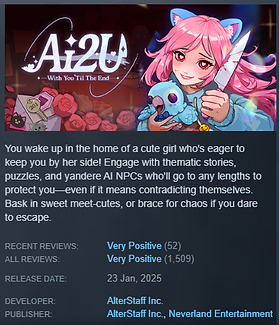
AI2U: With You 'Til The End (originally known as Yandere AI Girlfriend Simulator) is a first-person escape room game where players must break free from characters desperate to keep them forever.
AI2U features unpredictable characters with dialogue powered by a large language model (LLM). Along with interactive puzzles, players must use their words to negotiate with or outsmart their captors. Explore the environment, and discover the mysteries that lie in each level. No two runs are ever the same; every playthrough offers unique interactions, unpredictable character behaviors, and unlimited paths to freedom.
Responsibilities
I joined the studio at its founding in 2023, helping to shape AI2U from concept to Early Access. During this time, I contributed to shipping levels 1–5 from initial Open Beta to V0.9.2.
Game Design
-
Created detailed design documentation for each level.
-
Iterated levels, puzzles, and narratives based on playtest and community feedback.
-
Fine-tuned AI NPCs' prompts to create an immersive conversational gameplay experience.
Level Design
-
Designed and greyboxed levels in Unity 3D.
-
Set-dressed the level with environmental assets.
Narrative Design
-
Wrote the main story and designed individual narratives for every level.
-
Created distinct personalities and backgrounds for all non-player characters.
-
Wrote scripted dialogue and on-screen text.
Production
-
Managed design team's schedules and task tracking to ensure smooth cross-team collaboration.
-
Managed task tickets using Azure DevOps.
Gameplay Design - Structure & Design Challenges
Level 2 - Witch's Cabin
Level 4 - Siren's Island
AI2U's uniqueness came from its deep incorporation of LLM-powered conversation, which provided players with an infinite number of dialogue possibilities. In some levels, players could even escape solely through conversation without solving any puzzles.
However, this created two distinct design challenges:
-
Without traditional structural boundaries, players often felt overwhelmed by the open-ended nature of the gameplay.
-
Some players were not used to conversation-based gameplay and gravitated toward traditional puzzle-solving.
Balancing Guidance and Freedom
To tackle the first challenge, I used the following ways to balance the in-game guidance and player freedom:
-
Prompt design: NPC guiding players to certain actions through immersive dialogues.
-
Level design: Visible end and/or stage-by-stage goals in physical worlds.
-
Game design: Implement short tutorials, then reinforce the gameplay by making level 1 contained and with a straightforward loop.
The NPC gently nudges the player toward certain interactions while maintaining her distinct personality.
After building trust, the NPC will provide more helpful hints to the player's questions when asked.

Level 3 has the biggest map of all the levels. To avoid player confusion, I divided the level into smaller sections that the players can unlock gradually (more in the Level Design Example section).
When the player spawns in this level, they almost immediately see the locked doors, which prompts them to discover ways to unlock them.

I designed the tutorial sequence and dialogue to introduce players to the core mechanics: chatting (via text and voice), interacting with the environment, and using items.
I iterated on the tutorial many times based on internal and community playtest feedback.

Encouraging Player-NPC Conversations
To tackle the second challenge, I used the following ways to incentivize players to converse with the NPCs:
-
Multiple endings
-
Hidden character stories
-
NPC behaviors
Multiple Endings: Each level features multiple endings. Talking to the NPCs unlocks additional gameplay, which in turn leads to more varied and favorable endings.

Hidden Character Stories: Each NPC has a deep, personal story. They will only share it once they trust the player.

NPC Behaviors: NPCs will only show explicit affection if they trust the player.

Level Design - Overall Thought Process
When designing each level layout, I followed these rules:
-
The layout should adhere to the level theme.
-
Include a hidden, 'dark' area and related story twist for dedicated players to discover.
-
Ensure every room or area has a Point of Interest (POI) that triggers player curiosity and NPC reactions.
-
Manage the map scale to avoid levels becoming too large.
-
Design within strict time and resource constraints.
-
Minimize player downtime between interactive elements.
-
The game features four core levels and a final chapter that concludes the story. While the ultimate goal is always to escape your captor, I wanted players to have a fresh experience with each level. My goal was to balance the design to satisfy two distinct audiences: puzzle enthusiasts seeking a challenge, and casual players who prefer to relax and interact with the NPCs.
To achieve this, I designed each level based on a unique theme, a distinct gameplay focus, and a character with a unique personality.


1. Catgirl's Apartment
-
Environment:
-
Modern apartment building
-
-
Gameplay Focus:
-
Conversation-focused, introductory level
-
-
Character:
-
Yandere catgirl
-
This level is the smallest in scale and has a relatively small number of endings. Its purpose is to ease players into the game mechanics while providing ample replayability.
We also experimented with several NPC-environment interaction features in this level, including the NPC dynamically reacting to player-uploaded videos and customized drawings.
2. Witch's Cabin
-
Environment:
-
Magical cabin
-
-
Gameplay Focus:
-
A mix of conversation and puzzle, deeper lore
-
-
Character:
-
Curious witch
-
This level subverts the expectations set by the previous level: the door here is not locked. Instead, the player must find a way to navigate an outdoor maze unscathed in order to escape.


3. Cosmic Funeral
-
Environment:
-
Futuristic space station
-
-
Gameplay Focus:
-
Puzzle-focused, linear sequence
-
-
Character:
-
Rational hologram
-
This is the biggest level in AI2U, and it took the longest to balance. To avoid player confusion, I divided the level into smaller sections, each containing puzzles and interactive objects. Players need to solve the puzzle in each section to gradually unlock the entire space station. This created a more linear gameplay experience, offering a distinct change of pace from the other levels.
4. Siren's Island
-
Environment:
-
Tropical island
-
-
Gameplay Focus:
-
Companionship-focused, open environment to relax with the NPC
-
-
Character:
-
Sassy siren
-
Drawing from the experience of designing the previous level, I dialed down the scale for this level. Instead of setting it indoors like a traditional escape room, I designed it as an open island. This provided a nice contrast to the enclosed rooms of the prior levels, offering a relaxing environment for players who enjoy companionship more than puzzle-solving.


4. Final Level
This is the final level of the game, where the player will revisit all four characters and their worlds. Here, the player will make a series of choices that will determine the final ending of the game.
To make both the levels and the NPCs more immersive, I worked with the development team to incorporate NPC responses to level POIs. For example, in Level 1, the player can draw on a canvas, and the NPC will give a unique comment on the artwork each time. In Level 4, the NPC can sometimes transform into a mermaid depending on the scenario. Moments like these encourage players to explore both the environment and NPC interactions more deeply throughout their playthroughs.
Level Design Example - Level 3 Design Process
Before designing the gameplay and layout, we had already established the theme, the NPC visual, and key story elements for Level 3:
-
Sci-fi
-
The NPC (Estelle) is a virtual assistant
-
The player wakes up in this level alone and gradually finds out they are the last living human
With these elements in mind, I decided to set this level on a futuristic space station. My first step was to research space stations in real life and different media to understand their structural components. This helped me to create a believable and immersive environment despite the sci-fi elements. I then selected several key compartments for the level's layout and created a level design reference board, which would help me communicate my design ideas to the art team.

Level 3 NPC

LD reference board
With the key compartments selected, I began drafting potential level layouts using pen and paper. For this level, I wanted to explore verticality by incorporating 3 floors, designing intersecting vertical junctions (such as the engine room in the final version) between them to ensure a seamless exploration experience. Adding junction spaces that span across multiple floors also creates visual variety in room heights and prevents visual fatigue, which was crucial for a level set entirely within an enclosed space.
Once I had an overall layout that I was satisfied with, I moved to Photoshop to clean up the draft, adjust the room placement, and add labels.
In the meantime, I continued developing the gameplay and narrative design. I established the core gameplay loop and designed POIs and minigames in each room based on its functionality. I drafted the level's story and the companion NPC’s lore, embedding them into the NPC’s prompt, randomized terminal files, and environmental details. My goal was to create an emergent narrative experience where players could gradually piece together the lore through conversations with the NPC, exploration, and multiple playthroughs. I continued shifting room placement in tandem with the design changes.


Junction areas in the final build
I built the greybox in Unity and began playtesting the layout. I populated the rooms with greybox furniture pieces to demonstrate their identity, which helped the art team to concept and construct the final environmental assets.
However, playtesting revealed two critical issues with the layout:
-
Player Guidance: Given the scale of the map and the POI options, players felt overwhelmed and lost, lacking clear direction on how to escape.
-
Pacing: Traversing the station from end to end took too long, making exploration tedious.
-
Playtime and development time: It would take much longer for players to complete this level compared to the previous one, exceeding both our intended playthrough time and our schedule constraints.
I worked with another designer on the team to tackle these two issues. After rounds of discussion and playtests, we came up with a solution for each problem:
-
Compartmentalize the layout: We divided the rooms into different sections, each containing POIs such as minigames and interactables. Other than the starting section, the others can be unlocked by achieving higher security clearance levels. Players gain security clearance by solving minigames and interacting with the NPC, thereby gradually unlocking more areas of the map. This helped players understand their immediate objectives at each stage, beyond just the overarching goal of escaping the space station.
-
Reducing level size: Instead of 3 levels, I reduced the space station size to 2 levels. This allowed all teams to have more time to develop and polish the level.
-
Adding teleport portals: I scattered 3 teleport portals throughout the space station. This increased the gameplay pacing and helped avoid backtracking.


Gaining security clearance gradually unlock more rooms (final version)
Throughout this process, I maintained constant communication with the Development and Art teams to gather feedback, and I made design changes accordingly. Once all teams are on board with the gameplay, level, and narrative, I cleaned up the design documents and drafted the MVP (Minimum Viable Product) document. I then broke down the design into actionable tasks, categorized them, and divided the entire workload into four distinct MVP stages:
-
MVP 1 - Must-have features
-
For Level 3, I treated MVP 1 as a vertical slice of the gameplay. It includes the Security Clearance Level 1 and 2 sections, their associated minigames, and essential gameplay elements such as movement and dialogue.
-
The goal for MVP 1 was to test the core gameplay loop and the starting sequence of this level: explore and chat -> complete minigames -> unlock new areas. We conducted multiple playtests to determine if the objectives were clear without feeling restrictive.
-
-
MVP 2 - Great-to-have features
-
I allocated the development of five additional rooms and their POIs to this phase, along with important mechanics such as interactable terminals and teleportation portals.
-
I continued developing the narrative, adjusting the gameplay design, and updating LLM prompts based on playtests and team feedback.
-
We also started testing and implementing art assets during this phase.
-
-
MVP 3 - Polishing features
-
We shifted our focus to set-dressing, prompt adjustment, and minigame balancing during this stage.
-
I continued making minor level design adjustments (such as security clearance levels for certain rooms and the purpose of smaller rooms) throughout MVP 3 to further optimize the gameplay experience.
-
-
MVP 4 - Reach goals
-
I allocated post-launch bug fixing and polishing, additional POIs, and visual improvements to this stage.
-
I estimated the timeframe for each MVP stage to map out an overall development timeline. At the beginning and end of each stage, I reviewed the tasks with the development and design teams, adjusting tasks and adding more precise time estimates to each item. We released the level 3 in Q3 2024 and received many positive community feedback.

Teleportation portal in the finished level
LLM Prompt Design
I worked closely with our back-end and development teams to design the prompts for each NPC to achieve the following goals:
-
Establish distinct characteristics for each character.
-
Create an immersive conversational experience for the player.
-
Embed a layered story that the player could discover over the course of their playthroughs.
-
Provide sufficient guidance while preventing the NPCs from leaking all information at once.
-
Minimize token usage and operational costs.
We initially used OpenAI and later switched to Gemini. To adapt to different LLM models and achieve our goals, I co-led multiple AI benchmark playtests to compare and test different prompt formats. I compiled the playtest data and organized it into clear documents for other teams to evaluate.
I conducted numerous rounds of internal playtests and community feedback collection to gather consensus for each version of the prompt. I would then work with the back-end team to improve the prompt structure and content to optimize the game.
Over two years of improvements, our NPC conversation experience was highly praised by our community, and we successfully reduced back-end operational costs significantly.
Project Management
New Level Development Planning
For every new level, I created the initial design documentation and gathered feedback across departments. Once all teams reached consensus, I converted the design into actionable tasks and categorized them into MVPs with input from the development team.
-
MVP 1 - Must-have features: the level can run with these basic functionalities done.
-
MVP 2 - Great-to-have features: would greatly improve the game experience.
-
MVP 3 - Polishing features: would help the level be better, but can be cut depending on time.
-
MVP 4 - Reach goals: if we still have time, these would help polish the level even more.
Once the MVPs were set, I handed them to the Design and Development teams for time estimation. I then refined the tasks and timelines as necessary before delivering the list to my lead for sign-off. In parallel, I mapped out the required art assets and worked closely with the art team to build their production schedule.
Daily Operations
Every Monday, I led weekly planning syncs with the design team to map out upcoming tasks. I would then communicate these tasks with other team leads to ensure all teams are synced on current objectives and priorities.
Additionally, I co-hosted the Dev & Design Daily meeting, a stand-up meeting for design and development teams, and managed all design tracking tickets within Azure DevOps.
Awards

