Yibing
Chen


Game Designer & Level Designer

Mantra
Engine: Unreal Engine 4 & 5 | Rubyshark [Oct 2023 - Ongoing]
My Roles: Level Designer
Steam Demo: Play Now
Responsibilities
-
Design levels and create greyboxes in Unreal Engine 5.
-
Help create modular blockout kits by measuring all doors, wall runs, windows, and important pathways.
-
Modify existing level greyboxes to improve the gameplay flow and level purposes.
Level Greybox
Level 1: Expand on the existing level
I reworked the underground area of level 1: Security Base. In this game, players play as a character fighting against a powerful corporation with robot forces. Based on the gameplay and level progression, I identified several level goals:
-
Reinforce basic gameplay elements: wall-run and shooting
-
Establish game narratives


In this rework, I designed three new rooms, each with gameplay mechanics and a unique visual identity. Players descend via a lift into a storage hangar, wall-run through a vent, and reach a research lab where the company showcases its latest technology.
They then take an elevator to a meeting room overlooking several labs before entering a larger laboratory testing laser technology, which players later acquire. A laser gun destroys materials on a conveyor belt to demonstrate its function, and players must redirect it to break through a locked door and progress.


Level 4: Modify the existing level
For Level 4: The Mountain, I was tasked with modifying the existing level layout. I played through the level, and I identified three improvement goals based on the gameplay and narrative needs:
-
Incorporate more laser-gun-related gameplay (puzzles, traversal, etc.).
-
Give each room a clear visual identity.
-
Utilized existing Blueprints and scripted simple new ones to fill in missing level mechanics, making the level fully playable from start to finish.
This level is set within a deep mountain mine, where the in-game company extracts fuel for its robots. This mining facility was initially built by humans, but it later became largely automated.
I began my revision by dividing the original level into distinct beats and mapping out the golden path. I then researched real-world mines for inspiration. Following that, I used Figma to map out the level flowchart, defining the gameplay and visual purpose for each beat.


Level beat map, flowchart, and research/breakdown
When greyboxing this level, I paid attention to consistency and color-coding.
I color-coded the player-interactable objects and beat objectives in orange, contrasting them with the grey environmental objects. I also kept the design of the interactable laser target control panel consistent across multiple beats throughout the level.
This way, players can learn where they should go and what they can interact with while playing through the level. It also helps the Art Team to understand the purpose of these interatables.
The following are before-and-after examples of several beats:
Before

Beat 1: Mine entrance

Beat 5: Combat area


Beat 7: a puzzle area where players use the laser gun to activate targets, turn the target in the middle to connect all targets, and open the door


Beat 13: This is a major puzzle and a traversal beat in this level just before the final one. The original version was created a long time ago. It is too abstract and lacks many connecting passages and scripts, making it impossible to run through now.
After


Visuals: I wanted to show that this is the area where equipment and mined resources are transported in and out. I added storage, drills in action, and mine tracks.
Gameplay: I added an introductory laser gun puzzle, where players move the drill to carve out a path forward, to gently ease them into this interaction.


Visuals: I envisioned this place to be a collapsed mining site, so I put in mining walls and lava under the ground.
Gameplay: I added wallruns, terrain obstacles, and platforms to facilitate more movements during the combat.
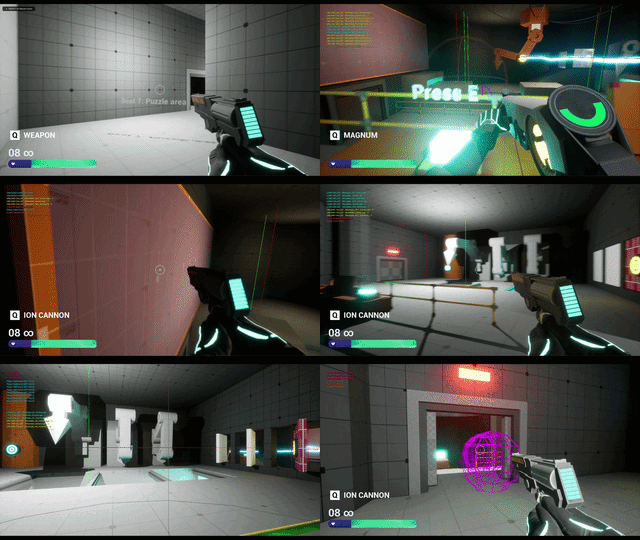


Visuals: I made this room a repair center for the mining equipment and bots.
Gameplay: Players face a more complicated laser puzzle in this room. I kept the core logic of the original puzzle and reworked it into the environment. Players need to rotate the mechanical arm to connect all laser targets, form a laser chain, and open the locked door.
I also implemented the environmental interactions by utilizing existing crane system blueprints.


Visuals: I was inspired by the OG version's cylinder space and tubes, and researched the mine/industrial ventilation systems. I transformed this room into the mountain ventilation center, which pumps fresh air into other areas. The bottom of the room is filled with water, serving both a narrative purpose for cooling and a mechanical purpose for player death.
Gameplay: Since this is the second-to-last room, I wanted it to incorporate traversal, puzzles, and combat without feeling overwhelming. I removed the smaller side rooms to focus on the main cylindrical space. Instead of ascending like in the original, players now descend from the top and circle the center pillar. This vertical layout highlights the beat's design while matching the Mountain Level's overall flow of descending toward the mine's core.
I utilized existing moving platform blueprints and scripted new environment interaction blueprints to prototype player interactions. The player's goal is to turn off the giant fans and use the ventilation tube to reach the next area. To do this, they must use the laser gun to reach three control rooms around the center pillar, each with a switch to cut the power. Once all three switches are off, the fans stop, allowing the player to pass.
Set Dressing
I set dressed a room based on a concept art of the office. The office space in MANTRA is bleak, industrialized, and brutalistic. I explored a more horror-esque direction with the given narrative and concept art. I created two different sets of lightings, dusk and night, as both can demonstrate a sense of eeriness.

Concept art & environment (dusk) comparison
The concept art depicts 8 office cubicles. I aimed to showcase some personality of each worker while maintaining the overall gritty, function-driven environment.
To do so, I designated a mini-story/theme for each cubicle. One person who just had his birthday, another was having a massive emotional crisis and overloaded their space with compulsive post-it notes. Behind them sits a highly tidy person who keeps everything symmetrical; at the corner is someone quirky who brings a doll to work ...
Above all, I designed an overarching narrative: the company was experimenting on a creature. It escaped the container, entered the office space through air ventilation, killed the manager, and left. Players can follow the paw print, blood trail, and frantically knock over pieces of furniture to decipher the story.


Slide for more images
Modular Blockout Kit


I measured the dimensions of doors, windows, platforms, wall runs, and vents in all levels. The data helped the art team to create a modular blockout kit, which improved the workflow for both level design and art team.